So, to make a long explanation, well, nonexistent, I'll say that my company has been forced to cut hours across the board, at least temporarily. Fortunately for me my employers opted for less hours than less pay per hour--the latter choice would have sent me into blind rage.
To be honest, this could work out very well for me. I'm only missing one day a week and able to keep my benefits, which I might not even need after the baby is born. I get a day off which will be devoted to my personal life which, you know by now, is much more valuable to me than the wage I make. It is supposed to be a temporary situation, but I have already posited that the new schedule could be beneficial to me as a permanent solution in that it could mitigate the cost of daycare once our baby is born. Instead of working to pay for daycare, I'd be daycare for at least a day... Not sure if my boss will buy into it once finances start picking back up, but I think I'll be sticking by that option.
Anyway, I'm not stressed, just a little weirded out, if not partially relieved that something really bad was avoided...
Showing posts with label economy. Show all posts
Showing posts with label economy. Show all posts
February 8, 2010


February 1, 2010
Kickstand Ramp: now charging
Today on Facebook I saw that Kickstand Pub was starting to charge $5 to skate their mini ramp. That's all I know--no idea what the exact reason is, who is affected, but I'm assuming the worst and I'm really disappointed. It's been open for 3 weeks, with no fee; why start now?
Once you start charging admission to skate, it's about business, not fun. Well, it is about fun--for the people who have connections and get to skate for free. After attendance starts dropping (which I expect), I won't be surprised if 90% of the people who are skating at any given time are people who aren't paying to skate (or drink for that matter). But for someone like me, to them, it's about money. I mean, if I can stop and reason for a second, I can ask myself why shouldn't I pay? It would be like buying a share in something of which I could have only dreamed, taking ownership and responsibility, like a food co-op. Perhaps the problem is that yesterday when I was there to skate, 8 out of 10 skaters were underage. Unfortunately Kickstand doesn't sell food, so at best they are only collecting money for beer from those over 21. For minors, not even that. And then you are only profiting on the mark-up of the beer. Either way, I would guess that their attendance on Sundays and Mondays has doubled or tripled (which doesn't paint an accurate picture, if you consider who is drinking and who isn't). Should they just charge minors that aren't going to be patrons? Aside from that issue, they are attracting new patrons who--because of the ramp--are establishing loyalties to the bar and, thus, a future patronage. In essence, the ramp could be looked at as an investment in more, future patrons. Think of the ramp like every one of Kickstand's 10 flat-screen TVs... but cheaper. I'm guessing about that number, but let's say each one is $550. Times 10. $5500. Plus the cost of cable. Consider the fact that of the 20 people in the bar at 5:00pm yesterday, 10 were there to skate.
But the fee they're charging isn't to pay for the ramp or its upkeep; there are ways around that: namely, sponsorships in the form of banners or stickers on or around the ramp (currently, they have one giant logo for a Harley Davidson dealership right in the middle). I bet you it's because they didn't realize that the paint was going to chip so bad and that they are going to have to resurface it again, and again, and again; and maybe they can't find sponsors. Bummer.
Maybe I'm just pissed it's going to be a choice between drinking a beer and skating. In past weeks, I would drop $6 for a beer and tip, maybe $12. Now, they are getting $5. Ok, so maybe I stop drinking the Sunday afternoon beers I've started to enjoy. Or just drink a beer at home. I can buy a six pack for less than they charge for 2 pints. I guess that will save me a good bit of money after all. Thanks Kickstand.
Thoughts?
--
Alden says "Hi."
Once you start charging admission to skate, it's about business, not fun. Well, it is about fun--for the people who have connections and get to skate for free. After attendance starts dropping (which I expect), I won't be surprised if 90% of the people who are skating at any given time are people who aren't paying to skate (or drink for that matter). But for someone like me, to them, it's about money. I mean, if I can stop and reason for a second, I can ask myself why shouldn't I pay? It would be like buying a share in something of which I could have only dreamed, taking ownership and responsibility, like a food co-op. Perhaps the problem is that yesterday when I was there to skate, 8 out of 10 skaters were underage. Unfortunately Kickstand doesn't sell food, so at best they are only collecting money for beer from those over 21. For minors, not even that. And then you are only profiting on the mark-up of the beer. Either way, I would guess that their attendance on Sundays and Mondays has doubled or tripled (which doesn't paint an accurate picture, if you consider who is drinking and who isn't). Should they just charge minors that aren't going to be patrons? Aside from that issue, they are attracting new patrons who--because of the ramp--are establishing loyalties to the bar and, thus, a future patronage. In essence, the ramp could be looked at as an investment in more, future patrons. Think of the ramp like every one of Kickstand's 10 flat-screen TVs... but cheaper. I'm guessing about that number, but let's say each one is $550. Times 10. $5500. Plus the cost of cable. Consider the fact that of the 20 people in the bar at 5:00pm yesterday, 10 were there to skate.
But the fee they're charging isn't to pay for the ramp or its upkeep; there are ways around that: namely, sponsorships in the form of banners or stickers on or around the ramp (currently, they have one giant logo for a Harley Davidson dealership right in the middle). I bet you it's because they didn't realize that the paint was going to chip so bad and that they are going to have to resurface it again, and again, and again; and maybe they can't find sponsors. Bummer.
Maybe I'm just pissed it's going to be a choice between drinking a beer and skating. In past weeks, I would drop $6 for a beer and tip, maybe $12. Now, they are getting $5. Ok, so maybe I stop drinking the Sunday afternoon beers I've started to enjoy. Or just drink a beer at home. I can buy a six pack for less than they charge for 2 pints. I guess that will save me a good bit of money after all. Thanks Kickstand.
Thoughts?
--
Alden says "Hi."
January 28, 2010
Education - Math & Science v. Humanities
Here's a pretty powerful quote from an article sent from a friend this afternoon:
The real problem, he explains, is the SAT writing exam, which “hardly resembles the kinds of writing people encounter in business or academic settings.” An accountant, he argues, needs to write “about content related to the company and the work in which she’s steeped.” It’s unlikely that she’ll “need to drop everything and give the boss 25 minutes on the Peloponnesian War or her most meaningful quotation.”
What’s depressing here is that this is precisely the argument heard at parent-teacher meetings across the land. When is the boss ever going to ask my Johnny about the Peloponnesian War? As if Johnny had agreed to have no existence outside his cubicle of choice. As if he wasn’t going to inherit the holy right of gun ownership and the power of the vote.
Get it? It's about the power of learning and understanding of history and current events, arguably called "education," because life shouldn't be about a wage but about human rights; information and awareness; language and activism.
The author goes says this later on:
[T]he problem today is disequilibrium. Why is every Crisis in American Education cast as an economic threat and never a civic one? In part, because we don’t have the language for it. Our focus is on the usual economic indicators. There are no corresponding “civic indicators,” no generally agreed-upon warning signs of political vulnerability, even though the inability of more than two thirds of our college graduates to read a text and draw rational inferences could be seen as the political equivalent of runaway inflation or soaring unemployment.
Original article:"Dehumanized: When Math and Science Rule the School" by Mark Slouka, Harper's Magazine online .
The real problem, he explains, is the SAT writing exam, which “hardly resembles the kinds of writing people encounter in business or academic settings.” An accountant, he argues, needs to write “about content related to the company and the work in which she’s steeped.” It’s unlikely that she’ll “need to drop everything and give the boss 25 minutes on the Peloponnesian War or her most meaningful quotation.”
What’s depressing here is that this is precisely the argument heard at parent-teacher meetings across the land. When is the boss ever going to ask my Johnny about the Peloponnesian War? As if Johnny had agreed to have no existence outside his cubicle of choice. As if he wasn’t going to inherit the holy right of gun ownership and the power of the vote.
Get it? It's about the power of learning and understanding of history and current events, arguably called "education," because life shouldn't be about a wage but about human rights; information and awareness; language and activism.
The author goes says this later on:
[T]he problem today is disequilibrium. Why is every Crisis in American Education cast as an economic threat and never a civic one? In part, because we don’t have the language for it. Our focus is on the usual economic indicators. There are no corresponding “civic indicators,” no generally agreed-upon warning signs of political vulnerability, even though the inability of more than two thirds of our college graduates to read a text and draw rational inferences could be seen as the political equivalent of runaway inflation or soaring unemployment.
Original article:
January 13, 2010
New tradition
I may have alluded to this before, but recently I've been swooning over traditional craftsmanship that is on the come-up.
Leather, waxed cotton, wool, cork... Materials that I am falling in love with. Here are some companies that I keep running into on the internet superhighway who have a pretty strong focus on traditional craftsmanship and traditional materials, beyond just being handmade crafts.
Billykirk - PA (www.billykirk.com ) - Leathergoods, est. 1999


Makr Carry Goods (www.makr.com ) - Leathergoods, est. 2009?

Field Notes (fieldnotesbrand.com ) - old-fashioned memo books
ML Brown & Co. (www.mlbrownandco.com )

Honorable mentions:
Freeman Transport - Montana (www.freemantransport.com ) est. 2006

Rapha clothing (rapha.cc ) - England


Outlier clothing (outlier.cc )

Howies "Hand-Me-Down" Collection (hmd.howies.co.uk )

Not to mention the randonneuring outfitters that peddle myriad handmade goodies (Rivendell - rivbike.com, Velo-Orange.com, Carradice Bags, Acorn Bags...)--all worth checking out.
Even a mainstream company like J Crew offers some pretty nice handcrafted stuff that fits into their traditional, maritime theme, and fetches a nice price for good reason...
Leather, waxed cotton, wool, cork... Materials that I am falling in love with. Here are some companies that I keep running into on the internet superhighway who have a pretty strong focus on traditional craftsmanship and traditional materials, beyond just being handmade crafts.
Billykirk - PA (


Makr Carry Goods (

Field Notes (
ML Brown & Co. (

Honorable mentions:
Freeman Transport - Montana (

Rapha clothing (


Outlier clothing (

Howies "Hand-Me-Down" Collection (

Not to mention the randonneuring outfitters that peddle myriad handmade goodies (Rivendell - rivbike.com, Velo-Orange.com, Carradice Bags, Acorn Bags...)--all worth checking out.
Even a mainstream company like J Crew offers some pretty nice handcrafted stuff that fits into their traditional, maritime theme, and fetches a nice price for good reason...
November 25, 2009

October 28, 2009
Marketing, Part II: Bikes
From Bikesnob :
The bicycle is a simple machine, and the significance of incremental improvements that are made to them every year is both debatable and relative. Sure, infinitesimal improvements in aerodynamics may, in theory, gain one seconds or fractions of seconds in competitive events, but in the end what matters is how much this supposed gain is worth to you. If you're a professional athlete this gain might be worth millions; if you're everybody else, it's probably worth nothing.
However, some people are willing to pay for the perception that their bike is the best, and since they can't actually prove this is true themselves because they're not capable of riding fast enough to make those incremental improvements count, they instead rely on the bike's manufacturer to create marketing campaigns that prove it for them.
October 22, 2009
Marketing
This is not necessarily related to the last post but it is about money. I am very critical of the stupid commercials I see on TV, and this one took the cake. An Aldi grocery store advertisement said this as it's "gotcha" tag line: "If you [shop here] and didn't save money, you must not have bought anything."
WTF?
You don't need to read that twice to realize how outstandingly dumb that statement is. Do people "buy" into that marketing? I'm sure the food and groceries are cheap at Aldi, but that marketing is a slap in the face to common sense.
I'll say that I have been impressed with Walmart's recent campaign--describing recipes for meals for entire families that cost, for example, $2 per serving. Brilliant. I mean, it's "effing" crazy that food can be that cheap. They're probably not particularly good and/or healthy meals, but it's brilliant marketing while the economy is so shitty.
WTF?
You don't need to read that twice to realize how outstandingly dumb that statement is. Do people "buy" into that marketing? I'm sure the food and groceries are cheap at Aldi, but that marketing is a slap in the face to common sense.
I'll say that I have been impressed with Walmart's recent campaign--describing recipes for meals for entire families that cost, for example, $2 per serving. Brilliant. I mean, it's "effing" crazy that food can be that cheap. They're probably not particularly good and/or healthy meals, but it's brilliant marketing while the economy is so shitty.
October 20, 2009
Interesting: 9 years without spending money
Daniel Suelo wasn't poor, a victim of bad luck, mentally ill, or even uneducated. He just decided that he wanted to have nothing to do with money. So he gave up consumer culture altogether, and for the last 9 years, he's survived by living in a cave in Utah, and dumpster diving, foraging, fishing, and occasionally hunting for food. He spends his time in the great outdoors--and in the public library, where he blogs about it all.
Suelo must have the lowest carbon footprint of any blogger in the United States. And he's never taken food stamps or other government assistance, and despite what his lifestyle may lead you to believe, he's certainly not crazy. He's just got an aversion to money.
(source:treehugger.com article )
Seulo's blogLiving Without Money
--
Response to FAQ #14: "You say you don't use money, yet aren't you using products of the money system & relying on the hard-earned money of others? [Revised October 10, 2009]"
Suelo must have the lowest carbon footprint of any blogger in the United States. And he's never taken food stamps or other government assistance, and despite what his lifestyle may lead you to believe, he's certainly not crazy. He's just got an aversion to money.
(source:
Seulo's blog
--
October 1, 2009
Bike payoff?
Miles Biked (year to date) ~550 miles
Car's gas mileage: ~27 mpg
Gas price per gallon (average for Regular grade in the Midwest, Jan-Sept 2009): ~$2.76 (source )
Saved: $56.20
Damn. I really thought that number would be like $200. Hahaha.
Car's gas mileage: ~27 mpg
Gas price per gallon (average for Regular grade in the Midwest, Jan-Sept 2009): ~$2.76 (
Saved: $56.20
Damn. I really thought that number would be like $200. Hahaha.
September 8, 2009
"Out Your Backdoor"
Just stumbled upon this website: OYB (or "Out Your Backdoor "). It's a DIY outdoor adventurer site, a collection of resources and philosophies to promote independent action culture and social creativity. Here's what OYB says about itself:
For now, I'll be posting OYB in the "Good Stuff" link list... Enjoy.
What is OYB? -- An HQ for Indie Outdoor Action
Hi, I'm Jeff Potter and I herd the cats here. OYB has been celebrating thrifty independent action culture since 1991, offering 1000+ hard-to-find stories, links, books and goodies (luggage, too!) that offer the Vision Thing that anyone can afford.
Hard times aren't new. They're the base condition for folk culture and social creativity. They can even be voluntary or not noticed. Doing without some consumer "necessities" can be freeing. What's hard for one is just right for another. Simplicity encourages hands-on culture, integration and versatility. Which makes us want to share and celebrate what we've found. But where? Here!
These efforts can sometimes be lonely. Also, it's easy to lose our bearings. So, again, OYB is a place to share what it's like for you and show how we can make it all work together.
Then, too, indie culture is a great good source of sustainable creative reality for anyone, no matter what their situation. Flush times, lean times, it works.
Hi, I'm Jeff Potter and I herd the cats here. OYB has been celebrating thrifty independent action culture since 1991, offering 1000+ hard-to-find stories, links, books and goodies (luggage, too!) that offer the Vision Thing that anyone can afford.
Hard times aren't new. They're the base condition for folk culture and social creativity. They can even be voluntary or not noticed. Doing without some consumer "necessities" can be freeing. What's hard for one is just right for another. Simplicity encourages hands-on culture, integration and versatility. Which makes us want to share and celebrate what we've found. But where? Here!
These efforts can sometimes be lonely. Also, it's easy to lose our bearings. So, again, OYB is a place to share what it's like for you and show how we can make it all work together.
Then, too, indie culture is a great good source of sustainable creative reality for anyone, no matter what their situation. Flush times, lean times, it works.
For now, I'll be posting OYB in the "Good Stuff" link list... Enjoy.
August 19, 2009
Health, science
I haven't had much to say lately. I read all "my blogs" (kinda like watching "my stories"), which have actually become a bit boring. I even scan through the blog-rolls of those blogs. I flip through the lists of bikes on Craigslists between Cincinnati and Cleveland. Sometimes I peek at Pittsburgh and Indianapolis.
Otherwise, work has been pretty busy lately and will continue to be busy for the rest of the summer. Allergy season has begun and I already feel the start of a sinus infection. Dammit.
Meanwhile, the one thing that has been fluttering around my headspace has been health care reform. What a nightmare. Right when I think I understand what's going on, I realize I have no clue. Meanwhile, I've managed to absorb some of the noise from the far-right Republicans, and insofar as I associate with leftish Democrats, I tend to let it really bother me. I've got this tendency to take shit so personally and get bent out of shape about stupid things. And usually it's just stupid, petty, trivialities.
The big stuff? I just don't get it. Policies and economics aren't my forte. That's why I dove into science and biology. It's all about facts. Facts and laws of nature. Indisputable (I guess, theoretically, haha). For the most part, opinions are left out of it. Of course, you can use it to justify opinions about stuff like climate change and vegetarianism. Overall, I deal really well with science and it makes beautiful, harmonious sense in my head.
So, I guess until I feel like I understand political theories and economic philosophy, I'll try to avoid it and be cautious to form opinions.
As for now, I'm assuming universal, public-option health care sounds pretty respectable, reform seems essential, and people worried about government spending should focus attention on ending our wars [tip of the hat toOnly One Manda for making that point]. In the meantime I'll try to follow what's going on, beneath the shouting and soundbites. If there's one thing I don't trust, it is the lot of insurance companies. I've heard enough horror stories about getting shafted or getting dropped at times when insurance should step up.
Otherwise, work has been pretty busy lately and will continue to be busy for the rest of the summer. Allergy season has begun and I already feel the start of a sinus infection. Dammit.
Meanwhile, the one thing that has been fluttering around my headspace has been health care reform. What a nightmare. Right when I think I understand what's going on, I realize I have no clue. Meanwhile, I've managed to absorb some of the noise from the far-right Republicans, and insofar as I associate with leftish Democrats, I tend to let it really bother me. I've got this tendency to take shit so personally and get bent out of shape about stupid things. And usually it's just stupid, petty, trivialities.
The big stuff? I just don't get it. Policies and economics aren't my forte. That's why I dove into science and biology. It's all about facts. Facts and laws of nature. Indisputable (I guess, theoretically, haha). For the most part, opinions are left out of it. Of course, you can use it to justify opinions about stuff like climate change and vegetarianism. Overall, I deal really well with science and it makes beautiful, harmonious sense in my head.
So, I guess until I feel like I understand political theories and economic philosophy, I'll try to avoid it and be cautious to form opinions.
As for now, I'm assuming universal, public-option health care sounds pretty respectable, reform seems essential, and people worried about government spending should focus attention on ending our wars [tip of the hat to
July 24, 2009
"To a certain extent, the sky's the limit."
words of a Chevron employee while standing on a floating oil rig, 160 miles from the coast, 7000 feet above the ocean floor in the Gulf of Mexico, that pumps 65,000 barrels/day from depths to 32,000 feet below the platform
--
Americans constitute 4% of the global population, yet we consume 25% of the world's oil (which is 2 times more than China and India combined).
--
"We operate like we have oil because we used to have oil." -T. Boone Pickens
--
(stuff I learned from a T.V. special about oil consumption on ABC)
-----------------------------
Sounds like we have to turn a lot of stuff around.
Go ride a bike this weekend.
--
A political cartoon for the weekend:
 Reblogged on GetBuck
--
Americans constitute 4% of the global population, yet we consume 25% of the world's oil (which is 2 times more than China and India combined).
--
"We operate like we have oil because we used to have oil." -
--
(stuff I learned from a T.V. special about oil consumption on ABC)
-----------------------------
Sounds like we have to turn a lot of stuff around.
Go ride a bike this weekend.
--
A political cartoon for the weekend:
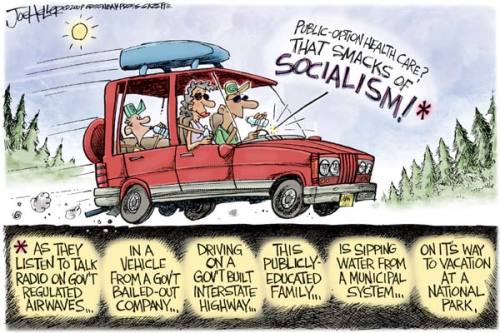 Reblogged on GetBuck
June 11, 2009
Dolla dolla bills y'all
More than ever in my life I've been enjoying professional basketball. It started with following the Cavs this season and has continued through to The Finals. During tonight's game, an announcer noted a particular player's contract--in this case: $22 million over five years. C went to the computer and found--to no one's surprise--Lebron James makes an estimated $14mil/year on the court plus $13mil/year off of the court (source: unsubstantiated internet site). Re-donk-u-lous.
Of course this conversation is old. I guess as a newcomer to pro sports normality, I'm not yet numb to the scale of those numbers. Really, I can't even imagine the fullness of that amount of money. But sadly, I occasionally yearn for a slice of pie so big. It's hard to not.
It's part Nature: to gather, hoard, provide, and succeed (in the Darwinian sense); it's part Nurture: to compete, excel, and work our way up the social ladder in a society that historically measures success and happiness in money earned and spent. Providing for your family and friends is a good feeling, so it's obvious we would want a lot of resources so we can share with the people we love. Selfish and un-selfish at the same time.
But how much is too much? We currently have so much more than MOST people in the world will ever have. That's pretty dumb-founding and heart-breaking too.
--
Update:
My dad sent me a link to this article about the top-paid athletes. I didn't even want to read it but couldn't avoid seeing this number: $110mil/year for Tiger Wood ::barf::
Article here (copy to browser): http://sports.yahoo.com/top/news?slug=ys-forbestopearners061809&prov=yhoo&type=lgns
Of course this conversation is old. I guess as a newcomer to pro sports normality, I'm not yet numb to the scale of those numbers. Really, I can't even imagine the fullness of that amount of money. But sadly, I occasionally yearn for a slice of pie so big. It's hard to not.
It's part Nature: to gather, hoard, provide, and succeed (in the Darwinian sense); it's part Nurture: to compete, excel, and work our way up the social ladder in a society that historically measures success and happiness in money earned and spent. Providing for your family and friends is a good feeling, so it's obvious we would want a lot of resources so we can share with the people we love. Selfish and un-selfish at the same time.
But how much is too much? We currently have so much more than MOST people in the world will ever have. That's pretty dumb-founding and heart-breaking too.
--
Update:
My dad sent me a link to this article about the top-paid athletes. I didn't even want to read it but couldn't avoid seeing this number: $110mil/year for Tiger Wood ::barf::
Article here (copy to browser): http://sports.yahoo.com/top/news?slug=ys-forbestopearners061809&prov=yhoo&type=lgns
May 29, 2009
"In the year two-thousand..."
Surely, every generation finds itself in the middle of some pretty huge changes that gives that generation an identity in history.
Despite the inherent vagueness of the definition of "generation", everyone believes and understands they are part of some sort of generational bond with those around them.
In my (our?) case, the newest change might include this recession. Despite it's temporary nature, it could likely affect how the global community interacts from here on out. I'm not even going to get on with Information Technology. The speed of the expansion of modern technologies makes me want to laugh and puke at the same time--kind of like being on one of those carnival rides that demonstrates centrifugal force. I'm proud to say I almost got through high school without the internet or cell phones. Currently I'm getting along fine without an iPhone.
What might be a bigger phenomenon defining this generation is climate change and how we respond to it.
I just read this strange article about the future of farming (published byThe Columbus Dispatch ; found at Columbus Community Gardening ). Is it possible that farms of the future will in fact be massive, self-contained greenhouses? My gut reaction at the end of the third paragraph was that this was a total environmental catastrophe waiting to happen. Apparently it's not: energy-neutral, sustainable, water conserving, fertilizer reducing, production-increasing, worker-friendly future farms... It is Biodome come to life.
Currently, family farms seem to be disappearing--not due to the climate, but other problems. At best, big, trend-conscious cities are experiencing a spurt of small farms peddling organic, heirloom, free-range goodies--which is sort of a throw-back to pre-War agriculture. But these hip farmsteads, especially, won't survive severe climate changes that scientists are predicting.
Farming (or "raw food production") can't die, but it's apparently possible that farms and Agri-Culture as we know them might. Obviously farms have changed a lot over the years, and I'm not a big fan of what are known as "conventional" mega-farms that, collectively, are the monster of the Industrial Agriculture Revolution. (Fun fact: agriculture developed roughly 10,000 years ago.)
So, it occurred to me that the end of farming might be impressed upon my (our!) generation. I can't really say how the disappearance of a farm might affect my daily life other than I pass them on the highway and I appreciate the aesthetics of their seasonal variation; I take comfort in the fact that farms have a potentially positive ecological relationship with the surrounding natural environment as they might benefit animals and watersheds, to say the least. Also, while I've decided to not pursue a life in the Country, I care about the preservation of Rural America which is part of my identity in many ways.
And consider this: if farms are being replaced by greenhouses because of the climate, how soon will neighborhoods turn into big, climate-controlled bubbles?
Despite the inherent vagueness of the definition of "generation", everyone believes and understands they are part of some sort of generational bond with those around them.
In my (our?) case, the newest change might include this recession. Despite it's temporary nature, it could likely affect how the global community interacts from here on out. I'm not even going to get on with Information Technology. The speed of the expansion of modern technologies makes me want to laugh and puke at the same time--kind of like being on one of those carnival rides that demonstrates centrifugal force. I'm proud to say I almost got through high school without the internet or cell phones. Currently I'm getting along fine without an iPhone.
What might be a bigger phenomenon defining this generation is climate change and how we respond to it.
I just read this strange article about the future of farming (published by
Currently, family farms seem to be disappearing--not due to the climate, but other problems. At best, big, trend-conscious cities are experiencing a spurt of small farms peddling organic, heirloom, free-range goodies--which is sort of a throw-back to pre-War agriculture. But these hip farmsteads, especially, won't survive severe climate changes that scientists are predicting.
Farming (or "raw food production") can't die, but it's apparently possible that farms and Agri-Culture as we know them might. Obviously farms have changed a lot over the years, and I'm not a big fan of what are known as "conventional" mega-farms that, collectively, are the monster of the Industrial Agriculture Revolution. (Fun fact: agriculture developed roughly 10,000 years ago.)
So, it occurred to me that the end of farming might be impressed upon my (our!) generation. I can't really say how the disappearance of a farm might affect my daily life other than I pass them on the highway and I appreciate the aesthetics of their seasonal variation; I take comfort in the fact that farms have a potentially positive ecological relationship with the surrounding natural environment as they might benefit animals and watersheds, to say the least. Also, while I've decided to not pursue a life in the Country, I care about the preservation of Rural America which is part of my identity in many ways.
And consider this: if farms are being replaced by greenhouses because of the climate, how soon will neighborhoods turn into big, climate-controlled bubbles?

Quote, marriage
For me I am standing back at that stove and I want a do over. I want to live this marriage so Cole knows that I am hers and that nothing is as important. Making more money to buy more things, keeping a house, mowing a lawn, taking the garbage to the street, all of these domestic annoyances that people let ruin moods and marriages are on my list of things to not let win over this love. So fuck that spinach.
-Ryan,Pacing the Panic Room
-Ryan,
May 22, 2009
quote/DIY
the do it yourself culture started way before the punks. people have always loved learning how to be better in touch with their surroundings by problem solving life’s inevitable breakdowns and becoming proactive in keeping their world functioning. it is great to learn how to fix a leak in your plumbing or not have to pay some stranger to do a simple oil change on a vehicle. learning to do it yourself aids in a lifestyle where one does not have (or want) a 40 hour work week. you can learn to get by on less by having to pay fewer people to do things you can easily do yourself. it is a great thing. when we learn how to fix things, our relationship between time and money shifts and our appreciation for the great, well functioning things in our lives grows.
from the chainbreaker bike book; a rough guide to bicycle maintenance by shelley lynn jackson and ethan clark
(stolen fromGet Buck )
from the chainbreaker bike book; a rough guide to bicycle maintenance by shelley lynn jackson and ethan clark
(stolen from
April 28, 2009
Work
Busting my ass at work - didn't get home until 11PM last night. I have super mixed feelings about all of it. Beautiful sunny day before a week of expected rain - perfect for planting 530 trees and getting sunburns. Working hard, pulling your weight, and giving extra effort can be rewarding in some ways or demeaning in others. I spent a lot of time agonizing over the tensions that characterize employer-employee relationships: expectations and effort... I thought about all the stupid decisions my boss was making, and focusing on all the things he wasn't doing. I was over-simplifying everything. When I realized late in the day that I was just going to have my ass busted until sundown, I stopped fighting it and relaxed a bit. I decided to stick to it, I also chose to enjoy a sit-down dinner with my coworkers instead of rushing home--it definitely made the day more pleasurable.
Working for someone else is hard, emotionally, especially if your only motivation is money.
--
And I didn't have to experience this, but no one at any job should make you feel like shit, and especially not tear you down in front of anyone else. That's some pointless, hateful, demeaning bullshit. Any person that thinks they can bully someone below them needs to be set straight Unfortunately, people with delusions of grandeur do have the power to abuse and the authority to keep people in check with fear. Is the job worth it?
Working for someone else is hard, emotionally, especially if your only motivation is money.
--
And I didn't have to experience this, but no one at any job should make you feel like shit, and especially not tear you down in front of anyone else. That's some pointless, hateful, demeaning bullshit. Any person that thinks they can bully someone below them needs to be set straight Unfortunately, people with delusions of grandeur do have the power to abuse and the authority to keep people in check with fear. Is the job worth it?
March 24, 2009
'Merica
The summer must be coming on because I've been finding myself away from home, let alone a computer, more and more lately.
Just got home from two days in Wooster, Ohio, where I learned how to take topographic data using a laser and surveying rod. I also learned that Rural America seems to be pretty estranged from Pop-Culture America. I think Pop Culture turned away from Rural America long ago, and in turn, Rural America has little to no interest in its Urban/Suburban counterparts. It's a damn shame because we all have a lot to learn from each other.
What else?
Oh yeah, driving along Interstate 71, I decided some things about fast food. I passed an exit that was infected with Applebee's, McD's, Arby's, and Wendy's, to name a few. I find myself eating at any one of these more frequently than I care to admit. The shame, I've decided, is that while it seems like at each exit on any national highway we have choices, we don't. The same pattern is seen all over. What's more, there is hardly any local flavor. It's the same from coast to coast. What this offers is speed and efficiency--which is great, if you want to consider yourself a heartless machine. I don't. I want to experience America as I'm driving around it. Okay, so I don't get out of Ohio much. I would like to experience what Ohio has to offer (which arguably includes Wendy's and Bob Evans). And maybe this sentiment would be an economic one also. I would say the same about material consumables, clothes, crafts, etc. Not stuff you'd find at Walmart, but at a small shop with local things.
Ok, gonna go hang with the fam. Peace, D
Just got home from two days in Wooster, Ohio, where I learned how to take topographic data using a laser and surveying rod. I also learned that Rural America seems to be pretty estranged from Pop-Culture America. I think Pop Culture turned away from Rural America long ago, and in turn, Rural America has little to no interest in its Urban/Suburban counterparts. It's a damn shame because we all have a lot to learn from each other.
What else?
Oh yeah, driving along Interstate 71, I decided some things about fast food. I passed an exit that was infected with Applebee's, McD's, Arby's, and Wendy's, to name a few. I find myself eating at any one of these more frequently than I care to admit. The shame, I've decided, is that while it seems like at each exit on any national highway we have choices, we don't. The same pattern is seen all over. What's more, there is hardly any local flavor. It's the same from coast to coast. What this offers is speed and efficiency--which is great, if you want to consider yourself a heartless machine. I don't. I want to experience America as I'm driving around it. Okay, so I don't get out of Ohio much. I would like to experience what Ohio has to offer (which arguably includes Wendy's and Bob Evans). And maybe this sentiment would be an economic one also. I would say the same about material consumables, clothes, crafts, etc. Not stuff you'd find at Walmart, but at a small shop with local things.
Ok, gonna go hang with the fam. Peace, D
February 10, 2009
Only One Manda: The Best Things In Life Are Free [David's abridged version: the remix: volume 1]
...First of all, we're (and by "we," I mean middle class students in the United States) made to believe that having a degree is a good and useful thing. It is when the economy is good, but when the economy is looking like Germany right around the time when people were using deutschmarks as wallpaper, it's not quite so useful. Knowing a trade is useful. Because there's a market for it.
I'm pretty sure that there isn't a job market for 20 somethings with BA's in religion and MA's in Theological Studies and no experience doing anything. I'm not sure what I thought would happen, but I'm pretty sure I thought that any kind of a Master's Degree would at least ensure that I wasn't going to be living well UNDER the poverty level. That's weird, isn't it?...
I've been working my little ass off in Maryland, here. Two jobs. The usual. Then, poof, one of the jobs couldn't afford me anymore. They felt really bad about it, but I had to go. That's fine...
Some people aren't as lucky as I am, though. I wonder what's going to happen to them as we lose more jobs. I wonder what's going to happen to us as more and more qualified and eager workers can't find work because there simply isn't any to be found? I wonder what's going to happen to families with children to feed. To people who don't have the familial resources needed in times like these.
I have to hope that we'll be able to pull ourselves out of this awfulness as a country. As a collective of human souls who have each other's best interests at heart.
I hope we're going to be willing to take a cut in hours or forego a raise so that we can ALL keep our jobs. Not just some of us. Not just the lucky ones. ALL of us. A-L-L.
Think about that in the upcoming years. What are you doing to take care of your fellow human beings? What are you doing to usher in a time of concern for each other? Of common human decency?
Even though it might seem like it, now is not the best time to have an "every-man-for-himself" mentality. That's the kind of thing that kills us.
The empowering potential of the human spirit, I might argue, is the very BEST thing in life...
--
Last night I was watching the news and the report was about how a bunch of police recruits who have just completed all their training were being blocked from the police force due to city budget cuts. The report went on to say that a dozen recreational centers around the city are closing due to budget cuts. Here is my first thought: kids from homes or families that will potentially be broken by the economy are losing places to go play, socialize, and be safe, and instead are turned to the streets that have no police force to offer safety. Now, my cynical side argues that a police force could be corrupt or useless or whatever, that citizens should band together to protect themselves, and that the streets should fundamentally be just as safe. Is that the case? I don't know, but doubt it. Then again, I'm pretty insulated in a middle-class suburb that is likely going to keep its Rec Center.
I hope city budgets get fixed so that we're putting money into education and recreation--but where does that money come from? I have no clue... Maybe people should start paying for their trash services around here...
February 2, 2009
Reflections on Success/ The kids are alright
Over the weekend, I was speculating on whether I suffer from a fatal case of poor work ethic or just a temporary lack of inspiration by the options for work I see available to me. C, Amanda, Andy, and I had a discussion about "success" and, if I recall correctly, we had basically narrowed the definition down to making money by over-working. So, by being on-call 24 hours a day, 7 days a week, you can be "a success," I guess, says the guy on-call 24 hours a day. This indicates that success comes in direct conflict with building or strengthening relationships. Granted, there are trade-offs and compromise with everything. I can only be so dedicated to skateboarding or tattoos or bikes, because I have time I want to give time to C and Alden and the rest of my family and--uggh--work. C and I have been reflecting on the importance of money lately. I just can't find enjoyment in working a job that is not relevant to my life--spending 8 hours each day of the work week away from home, not doing a thing for myself or my family, except making money. What if I was devoting some of that (day-) time to a large garden, keeping it fertilized, well-watered, properly trimmed and harvested, free of weeds, AND producing year round?!
Even still, accumulating money seems to promise an indefinite (but probably unattainable) amount of satisfaction and the alternative seems very precarious--with happiness no more certain. I'm trying to figure out how to raise a family and give a kid everything I had and more: a daunting task.
[UPDATE: After receiving a few responses about the post above I realize I need to clear one (major) thing up that is less clear than I intended. The definition of success I referred to is not OUR personal vision of success, but it is our perspective of mainstream society's vision of success--which is coming at us from many different angles, including one guy Andy met who was constantly on his phone and who said something about being on it 24 hours a day to get where he was. I don't envy that type of "hard work." The whole post had come about because I don't know how to define success--will it be money I make or save? Will it be maximizing time spent at home, with family, and doing great things for my home and family? Probably the latter, or something similar to it. But more and more I am feeling like I need to solidify my definition of it so I can move in a new direction perhaps. I understand about balancing, compromise, and sacrifice--but I know there has to be a better way where we redefine success, place more value in home & family over careers. I guess I'm literally talking about "doing" versus "spending". You can work a job to make money to buy food (= spending)...or you can grow food (= doing). Then you don't need that amount of money, right?]
Even still, accumulating money seems to promise an indefinite (but probably unattainable) amount of satisfaction and the alternative seems very precarious--with happiness no more certain. I'm trying to figure out how to raise a family and give a kid everything I had and more: a daunting task.
[UPDATE: After receiving a few responses about the post above I realize I need to clear one (major) thing up that is less clear than I intended. The definition of success I referred to is not OUR personal vision of success, but it is our perspective of mainstream society's vision of success--which is coming at us from many different angles, including one guy Andy met who was constantly on his phone and who said something about being on it 24 hours a day to get where he was. I don't envy that type of "hard work." The whole post had come about because I don't know how to define success--will it be money I make or save? Will it be maximizing time spent at home, with family, and doing great things for my home and family? Probably the latter, or something similar to it. But more and more I am feeling like I need to solidify my definition of it so I can move in a new direction perhaps. I understand about balancing, compromise, and sacrifice--but I know there has to be a better way where we redefine success, place more value in home & family over careers. I guess I'm literally talking about "doing" versus "spending". You can work a job to make money to buy food (= spending)...or you can grow food (= doing). Then you don't need that amount of money, right?]
Subscribe to:
Posts (Atom)
